STEVEN TEITELBAUM MD FACS    310.315.1121   888.315.1121  


Revision of Breast Implant Problems

If you are considering breast augmentation for the first time, you want to be sure that you do it right. You obviously want to avoid the emotional distress, inconvenience, and expense of having to have an early revision. And doing it right the first time is the best chance to set you up for having a result that will be as long lasting and beautiful as possible.

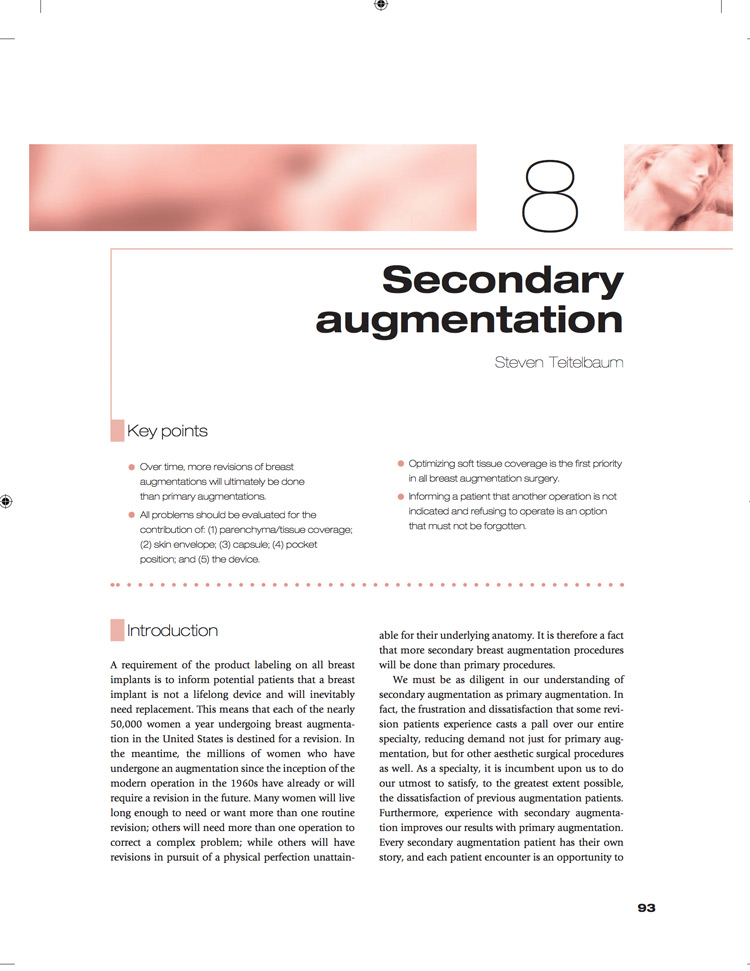
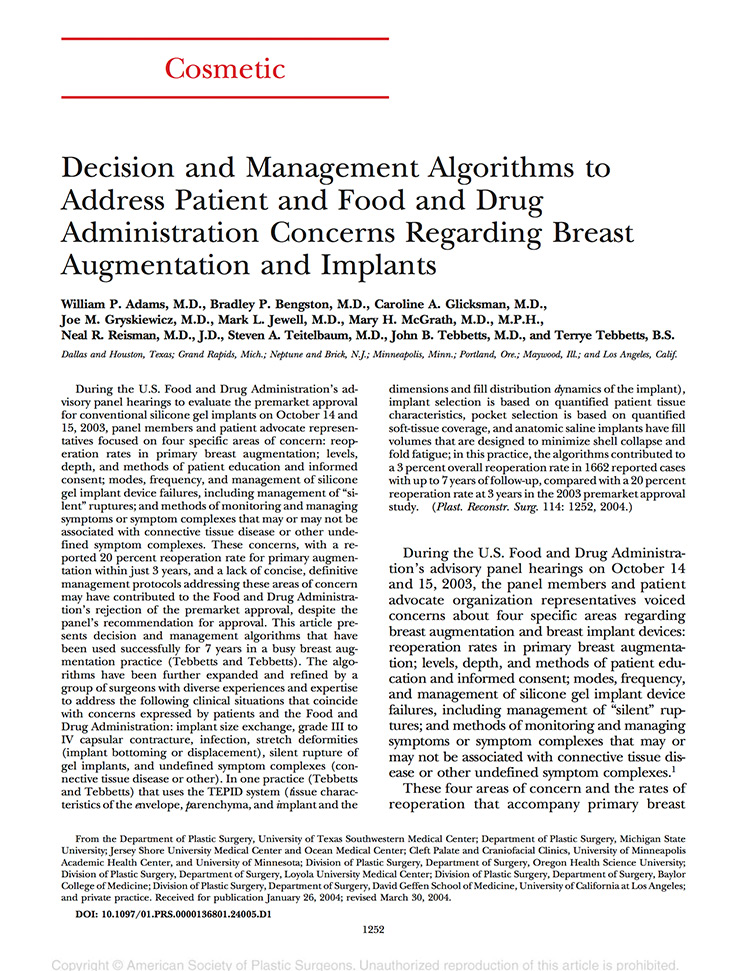
There are many women with serious and even permanent problems because of errors made with their first breast augmentation. Dr. Teitelbaum has learned from these women which choices in the first surgery can set a patient up for problems later. Using these principles, he was asked by an implant manufacturer to create an educational curriculum to teach other surgeons how to reduce their revision rates. And he is coauthor on a landmark paper that sets guidelines for surgeons to reduce the number of operations a patient will have in her lifetime.

Many surgeons approach this surgery with a very short-sighted view of their outcomes. Dr Teitelbaum recognizes the importance of achieving beautiful results not just for a year or two after the surgery, but for a patient’s entire life. While a surgeon that operates on a patient today is not technically responsible for a patient five years from now, Dr. Teitelbaum nonetheless recognizes that decisions made today will have effects years from now, and therefore counsels patients to make decisions that take this into account. He will always discuss with patients not just the short term effects of their choices, but what will happen to their breasts over time.

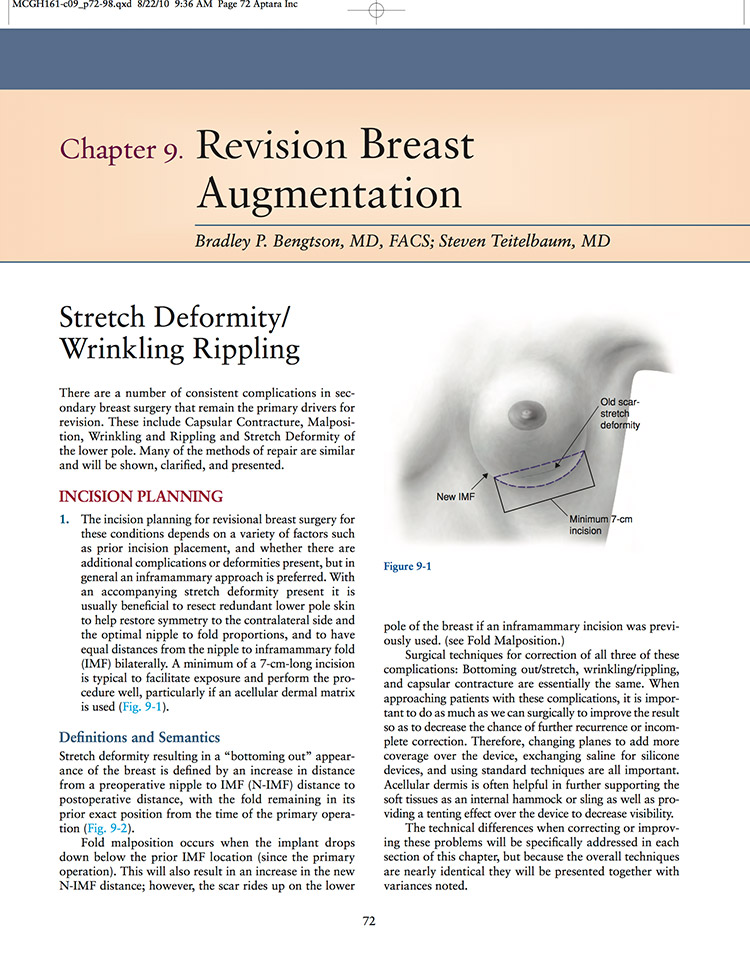
Other plastic surgeons refer Dr. Teitelbaum the most challenging cases that need revision. Having done so many of these revisions, Dr. Teitelbaum was asked to write a textbook chapter for an upcoming plastic surgery textbook entitled “Revision of Breast Augmentation.”

As complex as first-time breast augmentation is, revision is substantially more difficult. Patients’ anatomy may have been distorted with the past surgery, old records may have been lost, and tissues may have been thinned, stretched, or in other ways damaged. Worst, patients are frustrated, angry, and fearful after having spent a large sum of money and undergone one or more operations for a result that is totally unacceptable.

Dr. Teitelbaum understands these issues, and is aware of the spectrum of options to handle these problems, both “tried and true” and the new or experimental. For instance, he has a large experience using the cohesive or gummy bear implants, which can be helpful in many types of revisions because of their low likelihood of developing any visible folds or ripples. He is on the advisory board of a company named Lifecell which makes a special material derived from human or pig skin, working to find the optimal way to solve the most difficult augmentation problems. He is one of the pioneers of a new technique called the “neo retropectoral pocket,” which is a powerful and very effective technique that can be frequently applied in breast augmentation revision. He has coauthored a paper on using it to correct symmastia (the so-called “uni-boob,”) one of the most difficult problems to correct.

Capsular Contracture
This remains the most frequent cause for secondary reoperation. The best way to treat it is to avoid it in the first place. But if it occurs, it is important to take all the steps necessary to reduce its chance of recurrence. Complete removal of scar tissue, using a “low-bleed” implant, considering textured or cohesive implants, bloodless and gentle surgery, early post-op motion, and antibiotic irrigations are the cornerstones of treatment. Similarly, there are a few patients for whom recurrent contracture is unavoidable, and recognizing these situations and discussing whether or not to proceed is important as well.

Implant Malposition
The most beautiful women in the world all have asymmetry of their breasts. But sometimes an implant ends up so misplaced that it makes the asymmetry unacceptable and even causes deformities. The most common asymmetry is when one implant is too low. But they can be too close together, essentially joining in the center. This is known as symmastia (aka the uniboob deformity.) Or the implants can lay to far to the sides, widening cleavage and distressing patients by how far they fall out when they lay down. Treatment for all of these problems can be done by creating a new pocket. For instance, if an implant is in front of the muscle, a more even new pocket can be made behind the muscle, and vice versa. But if the pocket is already behind the muscle and there is good reason to stay behind the muscle, for instance to maintain good coverage over the implant, then one either closes off the lowered pocket with a technique called capsulorraphy or with something called a capsular flap. The newest way to handle this is with a technique called the neosubpectoral pocket, which creates a new pocket between the scar tissue and the muscle, using the strength of the scar tissue to correct the pocket malposition.

Droopiness
Sometimes an implant stays fixed in place and the breast can slide off it, drooping as a result of gravity. At other times, the implant itself falls down, stretching out the lower skin of the breast, which is known as “bottoming out.” These problems most frequently occur in women who had large implants and/or pre-existing stretched skin and perhaps droopy breasts before they even had their implants. That could have been the result of their own development, weight fluctuations, or pregnancies. Very often, these patients will recall being told that they needed a lift when they first had their augmentation, but decided against it because they didn’t want the scar. Each of these cases is very different, and care needs to be individualized.

Rippling/Visibility
Many patients complain that they can see or feel folds, ripples, or knuckles of implants. This happens mostly with saline, but it can even happen with silicone implants. If tissue is thin enough, this can even happen with the cohesive gel gummy bear implants, though that happens less frequently. Since he is an expert with the cohesive implants, many patients with this problem seek out Dr. Teitelbaum. While these implants do have an advantage over other implants for this situation, the underlying problem for most of these women is the thinness of their soft tissue over the implants. All of the patients with the worst rippling problems are extremely thin. The cornerstone of improving patients in this category is trying to get as much tissue coverage as possible, such as switching implants to behind the muscle if they are in front. Oftentimes, these patients have been behind the muscle, but they have stretched in the lower part of their breast, and by lifting the lower part of their breast, more of the implant can be kept under the muscle. Other techniques, such as using Strattice or Alloderm tissue implants can be very helpful in these challenging cases.

Size Change
This is an unfortunate reason for surgery. If there is adequate preoperative discussion and planning, this should be largely unavoidable, but it can still happen. Dr. Teitelbaum believes that implants should be sized at the first surgery according to what fits a patient’s particular breasts. Too big will look unnatural and stretch the breast, and too small will leave the upper breast underfilled and the breast looking empty and disproportional. So, if the implant chosen for the first surgery is that which was suggested – on these objective terms – then to change the size later would be illogical. That being said, sometimes patients go larger or smaller than was suggested to them initially, or other patients change their mind about what they want. This operation is not always as simple as just removing one and replacing with a bigger or smaller size. It can require some work to increase or decrease the size of the pocket, depending upon your tissues and the change in size. The most important thing to recognize is that if you are wanting bigger and bigger implants because your skin has a tendency to stretch, you need to stop and consider whether you should stop and have a lift, rather than progressively going larger, which inevitably will mean more stretch and emptiness later…one step forward and two steps back.

Saline Problems
With the end of the 14 year moratorium on silicone in the United States ending in November of 2006, there are hundreds of thousands of saline patients in the United States who at one time or another will come in to have their implants replaced. Despite evidence demonstrating that the fears that lead to the moratorium in 1992 were unfounded, some women nonetheless are suspicious of silicone. But most of the patients Dr. Teitelbaum sees want to have silicone. Some saline patients are bothered by firmness and roundness if their saline implants were highly filled, while others are bothered by upper pole emptiness, sloshiness, and ripples if their implants were underfilled. With saline, there was no perfect fill, and switching to silicone frequently fixes these problems. Other women have a saline deflation, and come in after one breast “disappeared” over a few days, and have both implants switched, either to saline or to silicone. Many are coming in now years after their saline, asking now to either replace their saline implants or get silicone implants so that a deflation does not occur at a time that is inconvenient for them. Some women asking to switch to silicone have nothing really wrong, except perhaps wanting a little softer and more natural of a feel, and something that is less perceptible to their intimate partners.

CORRECTING SYNMASTIA

Synmastia (also known as symmastia) is a condition that occurs when breast implants sit too close to the middle of the patient's chest. Some women refer to it as 'breadloafing" and extreme cases can even lead to the "uniboob" look. The problem can be corrected through breast augmentation revision surgery. This presentation by Dr. Steven Teitelbaum, M.D., F.A.C.S. explains in detail how to detect and repair synmastia. The pictures give you visual guidance while the text explains what you are looking at and how the repair is performed.

Dr. Teitelbaum is a plastic surgeon practicing near Los Angeles, California. He has extensive experience with both primary breast augmentation and with breast augmentation revision. He has compiled this presentation from actual cases of synmastia that he has revised recently.

This variety of patients with synmastia (symmastia) demonstrates the underlying problem: the implant is sitting too far towards the center rather than behind the breast itself. The markings indicate where the implant should sit; correction involves closing off the overly large space so that the implant remains where it looks best

There are cases in which the breast only crosses the center of the body when it is forcibly pushed over; this is still synmastia (symmastia,) albeit a more mild case.

Notice how her implants are so close that they are even touching! The implants should not have been allowed to migrate into the area of the hatched red line. The problem can be due to inadvertent overdissection by the surgeon, the shape of the patient's rib cage, the size of the implants, or weakness of the patient's tissues.

In addition to the implant pocket being open too far towards the center, it is often too low in many cases of severe symmastia (synmastia.)

Laying on her back prior to surgery, it is apparent how the implants come too close to the center and the skin over the breastbone is tented up into the air. The red hatch marks represent the area of her old implant pocket that needs to be closed off.

Many symmastia (synmastia) patients have somewhat of a depressed breast bone area; gravity can then pull an implant down the slope towards the center.

This patient has the opposite type of a breast bone: it is protuberant (the medical term for it is "pectus carinatum.") Note that gravity has pulled this patient's implants down towards her sides.

Correction requires closing off the hatched areas so that the implant just remains within the inner solid line. This can be done with sutures (capsulorraphy), placing a patch of material, or with the newest technique, creation of a new space called a neosubpectoral pocket.

With correction using the neosubpectoral pocket, the symmastia is totally corrected and looks smooth on the table at the end of the case. Note the wide gap between the new pocket and the line indicating where the old implant used to sit.

Immediately before and immediately after correction, still in the operating room. The implants now have a normal distance between them and the skin over the breast bone no longer "tents" from the pressure of the implants. It is often important to switch to a smaller implant in order for the symmastia repair to heal and for the problem not to recur. Imagine if the implant in the after photo below were a lot larger; it is easy to visualize how that would stress the repair and if large enough, may cause the skin to tent again over the breast bone.

Everyone wants cleavage but it must be smooth and even. As in this case, sometimes it is important to leave the breasts just a little wider than ideal in order to be sure that there is ample tissue to prevent recurrence of the problem.

Symmastia (synmastia) should be judged in a variety of positions. With the arms raised preop in the upper left, the joining of the breasts creates a "uniboob" type of a look which is shown corrected in the upper right photograph. While cleavage is good, note in the lower left how odd it looks when the skin pulls off of the breast bone. This is corrected as shown in the postop in the lower right photo.

Note how much deeper and more attractive the cleave is on the left. In the middle photos, note the severe extent of the tenting of the skin off of the breast bone. In the upper right, look how far the implant can be moved across the center, but how the implant is restricted to its side in the photo beneath it following repair.

In this severe case of synmastia (symmastia), the patient literally had a single pocket in which the implants were touching. Not all synmastia repairs turn out this excellent. Sometimes the tissue gets stretched from longstanding synmastia and other times it may have been damaged at the time of the first operation.

Her underlying problem is that her implants were way too wide for her body and crossed the centerline of her chest. The right was also too low. By raising them, moving them out, and making them a bit smaller, she enjoyed a significant improvement not just to the appearance of her breasts, but to their feel as well.

When implants are too close to the center, the nipples point out; when they are too low, the nipples point up. It is fascinating to note in symmastia (synmastia) patients how implants in the wrong place can so dramatically change the appearance of the nipples.

Note in the frontal view how much more even the implants are, and how they are no longer touching in the center. Cleavage is good, but the skin over this patients breastbone pulled away from her body when she would lean forward. Note that in the sideways view, her upper bulge is reduced but not eliminated. This was by the patient's own choice; had she selected a smaller implant, there would be less of an upper bulge and the nipple would not tip down.

In severe cases of symmastia with large implants that have been neglected for years, there is often stretch of the skin in the lower inner part of the breast towards the breast bone, leaving the folds that are seen. These could be improved with a lift, but the patient preferred leaving it as it is to having scars of a lift. It is also fascinating to look at the sideways photos and note how the nipple no longer points out to the side when the implant is properly positioned in three dimensions.

This is another example of a patient with severe, long term stretching of the skin over her lower breast bone. Such folds are usually only seen in thin patients with very large implants who have lived with their symmastia for years. She would need to have a lift if she would like to improve these. Note how an implant sitting too far towards the center doesn't just distort the center; the breasts in the preop photos are too narrow, they do not fill the width of her chest, and the result makes her whole torso look unbalanced.

This patient has successful correction of her symmastia, but no doubt some asymmetries still remain. The thinner the patient and the larger the implant, the more likely there is to be some residual deformities. But other than looking straight into a mirror or camera, her shortcomings are not noticeable. Large implants definitely contribute to causing symmastia, and placing large implants back in after correcting symmastia - as in this case, can still lead to implants that look more round than natural.

It is obvious not just that her implants did not sit symmetrically, but they are simply too big for her body. One of the most frequent causes for problematic outcomes after breast augmentation is selecting implants for which a patient simply does not have the room on her chest for them to be! Any patient considering an augmentation for the first time - as well as getting a revision - would be wise to choose an implant no larger than fits their body.

This is the same patient as shown in slide 11. Although her symmastia seems subtle when standing, it was actually quite severe and deforming in clothing. By creating symmetrical pockets within which the implants can sit, the breasts become noticeably more attractive for her torso.

For breast augmentation in Los Angeles contact Southern California Board Certified Plastic Surgeon Steven Teitelbaum today.

For more information about breast enlargement:


1301 TWENTIETH STREET, SUITE 350, SANTA MONICA, CALIFORNIA 90404     310.315.1121   888.315.1121

HOME | DR. TEITELBAUM | THE CENTER | PHOTO GALLERY | CONTACT US | PROCEDURES | SITEMAP | THE STAFF
SERENITY | DIRECTIONS | OUT OF TOWN | DERMATOLOGY | PATIENT IMAGING | FINANCING

Dr Teitelbaum is a board certified plastic surgeon specializing in breast augmentation, breast reduction, liposuction, tummy tuck, facelift surgery, and many other plastic surgery procedures. Serving the Los Angeles, Beverly Hills and Santa Monica area.

Other sites of interest Gynecomastia Surgery | Plastic Surgery Blog

Marketed by LookingYourBest.com