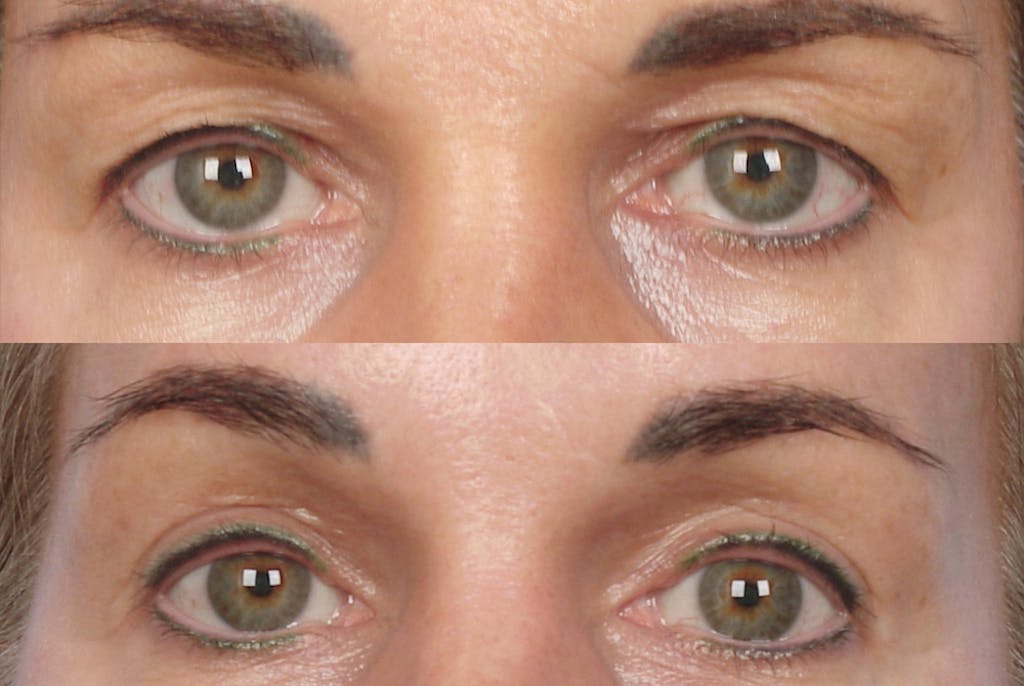
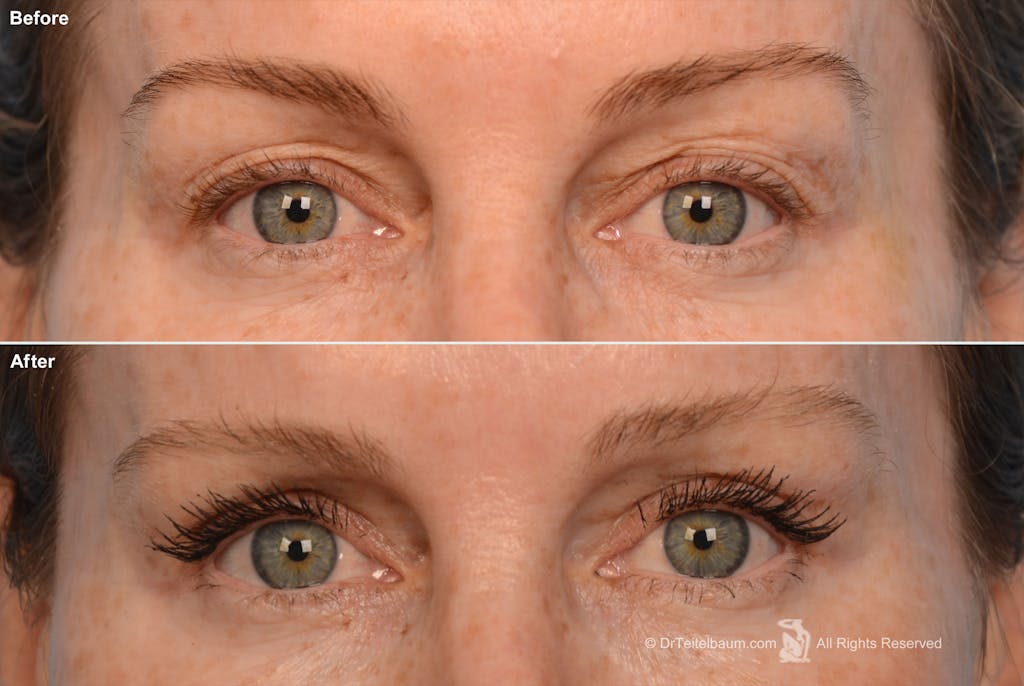
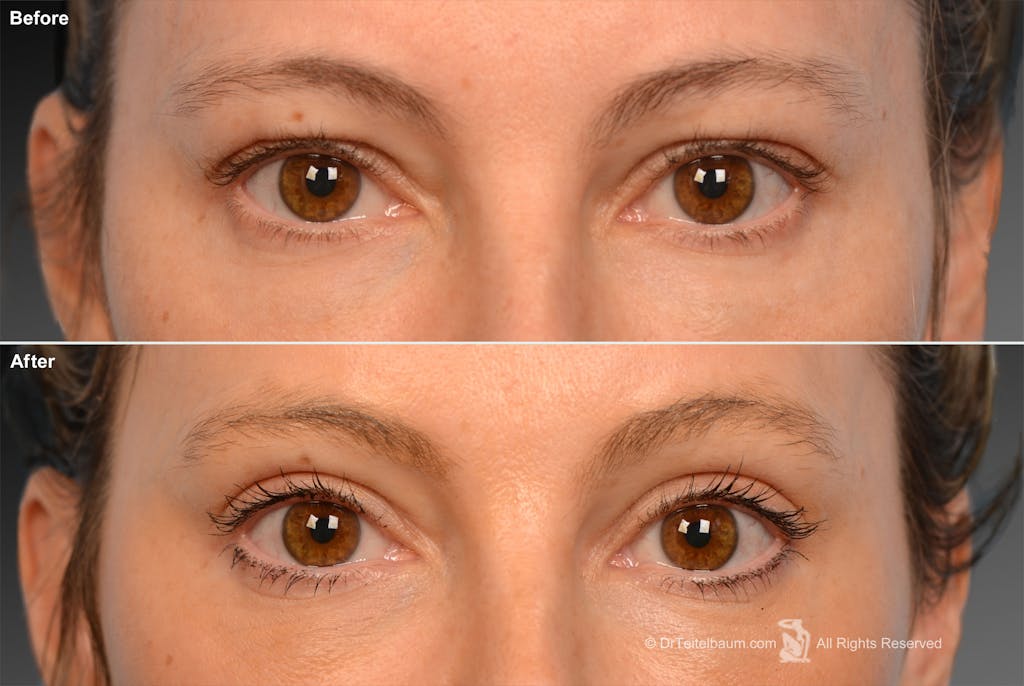
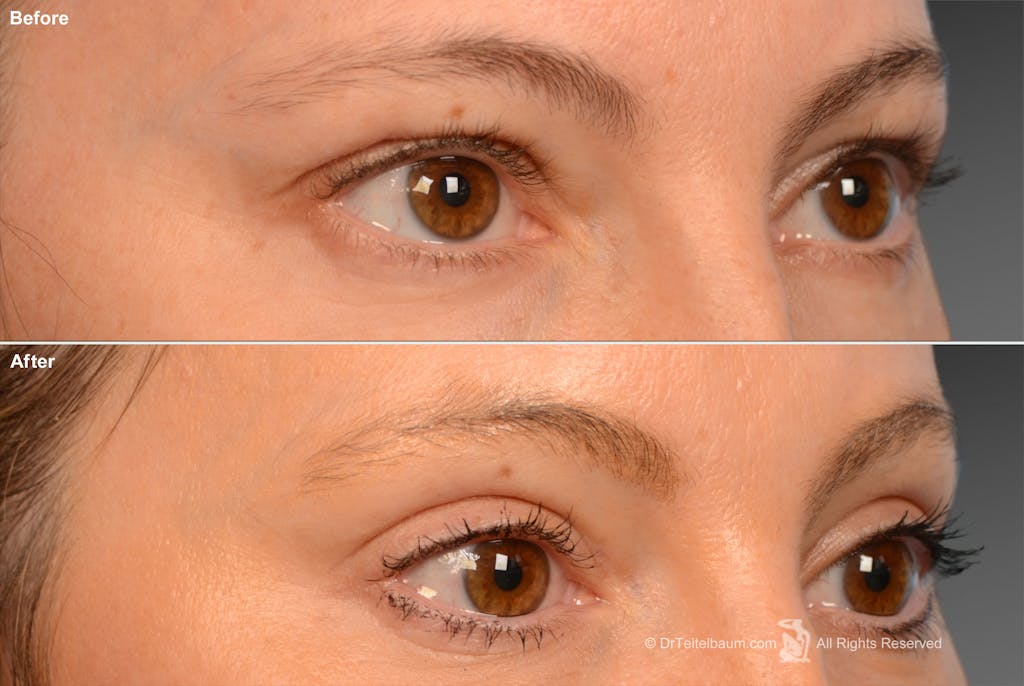
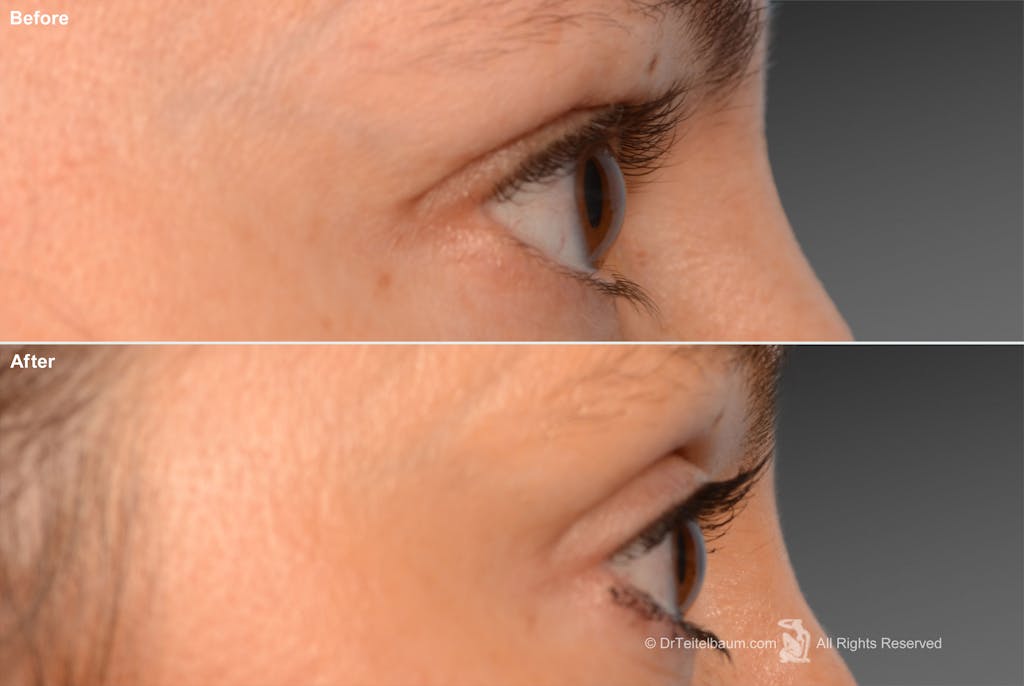

An upper blepharoplasty is for patients who have loose skin or bulges of fat in the upper lid. Some patients may complain about their eyelids feeling heavy at the end of the day. Rarely there is obstruction of the upper visual fields.
Eyelift Common Questions
The most important factors to consider when considering a blepharoplasty is whether the sort of an improvement the procedure does warrants the expense, risk, and recovery that comes along with the procedure.
While some patients have an upper eyelift in their early thirties, the peak for the operation is the forties. There is another peak in the fifties and sixties when a large number of patients have a facelift and the upper eyes are done in conjunction. Ultimately it is not a matter of age; it is when there is enough to do to make it worth doing.
Blepharoplasty incisions are made in the crease of the upper eyelid. Sometimes they extend a bit to the outside of the eyelid into a crow’s feet crease.
Plastic surgeons warn patients that there is always a scar after surgery. But the eyelid heals better than any other part of the body. The reason is that scarring seems to be related to the thickness of the skin and the eyelid has the thinnest skin (that is why scars on the back are almost always unsightly.) Eyelid scars are typicallyonly visible when your eyes are kept closed and someone who knows what they are looking for focuses on your eyelid from a close difference.
There are two rules of thumb. If the hooding extends beyond the corner of the eyelid, then you may need a browlift since an eyelift mostly has its effect on the lid skin itself. If you can push up your brows to an ideal height – not too high (!) – and the eyelid is mostly corrected, then you may need a brow lift. But if your brow has a nice arch (in a woman – a man usually has a horizontal bow) and is located above the eye socket, then an eyelift is what is usually done.
A blepharoplasty usually adds less than an hour to another procedure so it usually adds an insignificant amount of time or risk to a procedure. It is frequently done together with other facial surgery such as a browlift, facelift, fat injections, rhinoplasty, chin implant, or neck liposuction.
The treatment for deep lines in the crow’s feet area is injection with Botox® and/or a filler, and those only make subtle improvements. Sometimes moisturizer, retinoids, and vitamin C cream can help. A browlift can remove hooding of skin in the side of the eyes when it exists. But an upper blepharoplasty cannot be expected to improve that area.
The skin or fat that is removed will always be removed. Most patients never have another surgery. But Dr. Teitelbaum sees patients who had an upper blepharoplasty fifteen or twenty years earlier who are coming in for something else and decide to do a tweak. But usually that is just a minor touch up rather than an entire redo of the blepharoplasty.
The biggest mistake is removing too much skin. You can always remove more, but when too much is removed there can be problems with dry eyes and problems closing the eyelids. Most of the patients who have a blepharoplasty and later ask to have more removed actually are in need of a brow lift and expected more from the blepharoplasty than an upper blepharoplasty can do. Some may be unhappy with extremely crepey and sun-damaged skin, but no surgery changes the inherent qualities of the skin. It actually is extremely unusual for someone to ask to have a revision of their blepharoplasty.
No. A surprised look is the result of a browlift that makes the central portion of the brow too high.
Yes. Dr. Teitelbaum will make sure that he always leaves behind enough skin so that you can close your eyes normally.
Lasers can tighten skin a bit, not nearly as much as an upper blepharoplasty. But they can smooth the fine wrinkles in the skin, which is something that a blepharoplasty does not do. Some patients need one more than the other, and some need both.
This is a semantic question. The eye as a whole looks different and better, and to that extent the shape is different. But it does not change the fixed structures of the eyelid, such as where it attached towards the nose and to the temple, so the fundamental shape of the lids is unchanged.
An upper blepharoplasty can be done equally well with just local anesthesia, IV sedation, or a light general anesthetic. This often depends upon whether other procedures are being done which themselves require a general anesthetic, such as a rhinoplasty and often a facelift. General anesthesia and IV sedation cost more money, but many patients prefer being asleep. It is a personal choice and Dr. Teitelbaum can help you decide what will work best for you.
Eyeglasses can be worn right after a blepharoplasty, and in fact it is very common for patients to return for their visit the day after surgery wearing sunglasses as a means to mask any swelling they have.
You should wait about a week before wearing contact lenses after a blepharoplasty.
Patients with dry eyes should be under the care of an ophthalmologist. When this situation arises, Dr. Teitelbaum will discuss your case with your eye doctor find out if it is possible to do an upper blepharoplasty.
If an ophthalmologist documents an obstruction of your visual fields then you are entitled to have your surgery covered by insurance. However insurance companies are notoriously inconsistent on the criteria they use to determine if a procedure will be covered. Dr. Teitelbuam is not a participating physician in any insurance plans, so patients are expect to pay for services prior to surgery and then are reimbursed later by their insurance carrier.
An eyelift does not require the level of care of an aftercare facility unless the eyelift is being done along with another procedure, such as a facelift. But if a patient does not have someone to take them home or spend the night with them, then they might go to recovery.
Dr. Teitelbaum will give you pain pills, but most patients do not need to take any after a blepharoplasty; it is fortunately not a very painful procedures. Cold compresses for the first several days not only reduces swelling and bruising but really nips eyelid pain in the bud.
Patients work from home by computer or phone the day after their upper blepharoplasty. But the stitches don’t come out for one week, and there can be swelling and bruising around the eyes. If you can wear tinted glasses or if you do not mind if someone sees you like that, then you can return to work after three days. Otherwise plan on taking about a week off of work.
You can drive when you are off of all narcotic pain medication and feel totally unrestricted by your discomfort such that you could make any movement you might need to safely drive your car. That is ultimately a decision that I cannot make for you.
While you will ready to work out after about a week, there are rare cases in which people can cause bleeding up to two weeks after surgery, so Dr. Teitelbaum suggests you wait three weeks after your upper blepharoplasty before resuming your exercise routine.
It is okay to take a shower the night of an upper blepharoplasty.
You will be seen the next day, and then a week later for a check up. The doctor will then see you a month after surgery, and again a year after your blepharoplasty. But Dr. Teitelbaum allows patients to come back as often as they like.
Patients who are committed to icing will have very little bruising. But others can be dedicated to the icing and still develop bruising. In any case it is usually all subsided by a week after surgery.
By one week the bruising is usually gone. While the upper lids will still be a bit swollen for another week, most people can go out after a week without anyone commenting or seeming to notice that there is any upper eyelid swelling.
An upper blepharoplasty incision needs no special care. It is okay to get it wet right after surgery, even cleaning it gently with a soft washcloth. After the sutures are out, no special scar ointment is necessary because this part of the body heals so well.
The sutures will come out in 4-6 days after surgery. If you had an excision from around your nipple, those stitches are absorbable.
Usually the upper blepharoplasty scars are small and heal very well. The bottom line is that the fate of your scar is mostly determined by your own genetics and by the surgery itself. It is not clear the extent to which putting things on scars will influence their final appearance. However, most patients want to do something. There has never been a direct comparison between the various products. Patient feedback has been the most positive from three sorts of things: Scar Guard, which is a liquid containing steroid, Vitamin E, and silicone that you brush on like nail polish; Silicone gel strips (such as Neosporin scar strips); and silicone ointment (such as Scar Fade.) You can get these from the office or the pharmacy, and you can start putting them on once the glue or the steri strip is off, following the instructions on the packaging.
Upper and lower blepharoplasty have one unique complication that patients need to look out for. In very rare occasions, bleeding can occur that puts pressure on the eye. If left untreated, it can cause blindness. When such bleeding occurs, it is obvious to patients that there is a problem. The eye will become swollen, there is severe pain, and there can be loss of vision. If this happens, the doctor should be called immediately, and if they do not answer right back you should go immediately to an emergency room.
A lower eyelift removes bulging fat and/or skin of the lower eyelid. Loose skin is more typical in older patients and patients with a lot of sun damage. The bulging of fat is genetic, and starts to occur in the early forties. Though there are patients who in their thirties already have fat bulging.
Can the surgery make the changes you want? Are the risks and costs acceptable to you? Removing the puffy fat is highly successful. Removing a bit of extra skin is successful. But many patients expect that extremely sun damaged and crepey skin will be helped, and it is not. Skin problems are solved – or perhaps just improved – by skin care and lasers.
Deciding when to have a lower blepharoplasty is not an issue of age. It is purely a matter of when there is enough of an issue to be worth doing. Younger patients do not have excesses of skin. The young lower blepharoplasty patients will notice bulging of fat in their lower eyelids. That would be the time to at least get a consultation.
To remove fat the incision is made on the inside of the lower eyelid. The fancy name for this is transconjunctival blepharoplasty. If skin needs to be removed, then a small incision is made just beneath the lashes along the lower eyelid. In the past fat was removed from the external incision, but the problem with that is the surgery crosses all the layers of the eye, which can result in scarring throughout all of those layers, which can cause the lower eyelid to roll out. For this reason many surgeons today, Dr. Teitelbaum included, make a separate incision inside the lower eyelid when they need to remove fat. And since it is invisible, it is not something that a patient ever notices.
It is amazing how fragile the lower eyelid is; just a little tension on it from moving skin beneath it can pull it down, resulting in a loss of the crisp outer corner of the eye, eliminating the almond shape to the eye and showing too much white of the eye. If you look around, you will notice a lot of people who have this configuration of their eyelids. To avoid this, Dr. Teitelbaum is very conservative about whether he will remove skin, and when he does, to not be aggressive about how much he removes. And he will check for so-called lower lid laxity. He will pull out gently on the lower eyelid to see how quickly it snaps back. If there is a lot of laxity, he will do a procedure that tightens the lower eyelid so that it can withstand the pull of the removed skin.
In days past, too much fat was removed from the lower eyelid resulting in a hollowed out appearance. Plastic surgeons now realize that preservation of fat in the lower eyelids is important. If there is a pronounced bulge, then fat typically will be removed. But if there is not a lot of fat, but there is a so-called tear trough deformity, meaning a depression along the nose underneath the lower eyelid, then fat from the lower eyelid can be repositioned into this space to fill it up and smooth the contour of the lower lid.
There was a time when surgeons sought to remove too much fat, thinking that if removal of some of a bulge is good removing more fat would be better. But if you think about the appearance of a young person’s eyes, they are usually full. Hollowed can make someone look thinner, but they will look older. Only enough fat is removed so that the contour is smooth and any outward bulging is removed. Dr. Teitelbaum is experienced at this and will have a good idea just from looking at someone before surgery to know how much lower eyelid fat will need to be removed with their lower blepharoplasty. He will also assess the contour during surgery to be sure that it is smooth and even between the two sides.
For a transconjunctival blepharoplasty (for removal of just fat), fat is removed from inside the lower eyelid, so there is no visible scar at all. If skin needs to be removed, there will be a scar along the lower eyelid just beneath the lashes. This heals very well and is really not visible.
A lower eyelid lift can be done as the sole procedure, but it is safe to do with just about any other plastic surgery procedure. Patients who need a lower blepharoplasty frequently have other issues of concern, such as their upper eyes or face. A younger patient may also have excess fat in their neck or want a rhinoplasty.
A lower blepharoplasty only makes changes in the lower eyelid itself; it does not make changes out to the sides of the eyes in the crow’s feet area.
If skin is removed, some of the redundant skin will be removed. But if so much skin is removed that all the lower eyelid wrinkles are smoothed out, then it will pull down on the lower eyelids. Crepiness is obviously not a proper medical term, but in most people’s rhetoric it refers to extremely thin and fine lines that are the product of dry and sun damaged skin, not the sort of excess. Such fundamental problems with the underlying properties of skin cannot be totally corrected. But whatever improvement that is attainable will be a result of skin care or some type of laser or other external energy treatment.
The fat that is removed from a lower eyelid will never come back. As someone ages, there can be a bit more fat herniation, but that is fairly uncommon. Usually this is a once in a lifetime procedure. The same is true with skin removal.
The most common reason for operating again after a lower blepharoplasty is for removal of some excess fat out to the sides of the lower eyelid. It can sometimes be tricky to get it out and therefore it is sometimes missed by surgeons. Dr. Teitelbaum is aware of this and focuses on being sure that he gets this fat out.
If your circles are the result of a bulge creating a shadow underneath them, then there will be an improvement. But true changes to the pigment of the skin are not changed with a lower blepharoplasty.
Crepey skin is fixed only with skin care and a laser, radio frequency, or some other type of energy device. Small amounts of loose skin can be removed with an incision along the lower border of the lower eyelid along the lash line.
At best a laser can tighten the lower eyelid skin, but it cannot actually remove skin and especially it does not one thing to remove excess fat. If there is no true skin excess or bulging a fat, and if the problem is predominantly the skin, then a laser is the appropriate choice. But a lower blepharoplasty does not replace a laser when a laser is indicated and a laser does not replace a lower blepharoplasty when it is indicated.
It is possible to do a lower eyelid lift under local anesthesia, but given how close you are working to the eye, particularly with a transconjunctival (inside the eye) approach, patients are much happier with a general anesthesia.
When you feel ready to do your job is highly individualized. So long as your work doesn’t involve straining ad heavy lifting, you can expect to be back to work after three or four days. Bruising can last up to five or six days, so if you do not want anyone to see you with a bruise plan on being out of work about a week.
You can drive when you are off of all narcotic pain medication ad feel totally unrestricted by your discomfort and vision such that you could make any movement you might need to safely drive your car. That is ultimately a decision you need to make for yourself.
I suggest you wait 3 weeks. I want to be sure that everything is healed. There is always a chance of causing bleeding if you start much before that time.
You can shower or take a bath the same night as a lower blepharoplasty, even if you have stitches along the lower eyelid from a fat removal.
Patients that ice well the first 48 hours usually have little bruising. If there is bruising, it is usually gone by about a week.
Swelling increases after surgery, usually peaking about 5-6 days after surgery. After that, the swelling will subside, rapidly at first, and then gradually. After one month, you’ll think the swelling is gone, but it will still go down more at three months, ad even more at six months and even a year, though at that point changes are subtle.
The recovery and the pain after a lower blepharoplasty are relatively minor. Patients are given pain medicine but it is uncommon to take more than one or two of them. Just putting ice on the eyes is all that is usually necessary.
No. The pain is minor and it is easy for you to be taken care of at home by a friend. You really just need someone to bring you ice and your meals for the first day or two.
There are no stitches on the inside of the lower eye after a lower blepharoplasty and if you have stitches on the outside from removal of skin, those will dissolve.
Eyelid skin heals better than any skin in the body so there is no reason to do anything on the incisions to prevent scarring.
The biggest concern after a lower blepharoplasty is bleeding. If this occurs, there is severe pain on the one eye, the eye swells, and there can be loss of vision. This is an absolute emergency and you should call 911 immediately.